
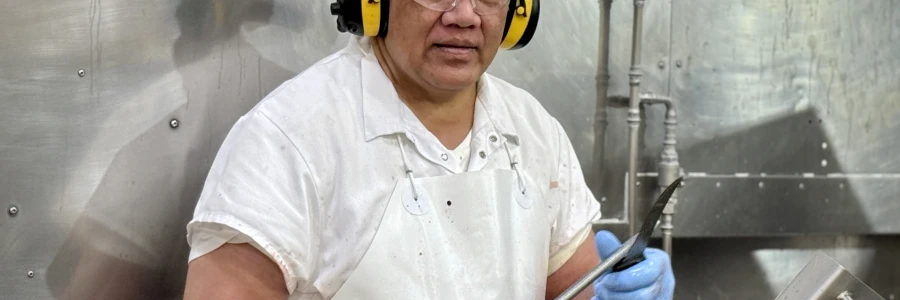
Knife safety | December health and safety focus
Posted on Friday, 5 December 2025 under Health & Safety,
Did you know the force required to use a blunt knife for one day is equivalent to the force of using a sharp knife for a week, and this can lead to strains. So, keeping your knife sharp is key to doing your job well and doing your job safely.
Setting yourself and your workstation up well is the first step to keeping safe around knives. Having good technique and the right equipment helps to reduce knife-related injuries.
Handling your knife correctly and ensuring it’s properly stored away in its pouch reduces knife-related injuries.
Following good knife safety processes is key to reducing risk of injury:
- Always use a sharp knife and know how your knife needs to be sharpened for different tasks.
- Throw away broken knives or sharpening equipment – ask your supervisor if you’re unsure where to put them.
- If you need to know how to sharpen your knife, ask your supervisor who can refer you to knife training, or ask your site’s knife trainer.
- Use the PPE that’s provided for the job – a mesh glove on the non-knife hand, a cut-resistant glove on the knife-hand, safety glasses, and a knife pouch. Avoid hitting your mesh glove against tables or other surfaces as this may damage it.
- Take short breaks, pouch your knife, stretch, and get your hands moving.
- If you’re not using your knife, make sure it’s in your pouch. This includes if you’re:
- Walking, talking, and moving around your workstation
- Lifting meat onto belts – avoid using your knife like a hook
- Starting other activities – knives shouldn’t be left on benches
- If a knife falls, don’t try to catch it. It could cut you, or you could knock it towards other people as you try to catch it. Stand back and let it fall to the floor, then pick it up and sterilise it.
- Cut away from yourself wherever possible and be aware of other people around you when using your knife. If you are required to cut towards you, mesh PPE is required.


