
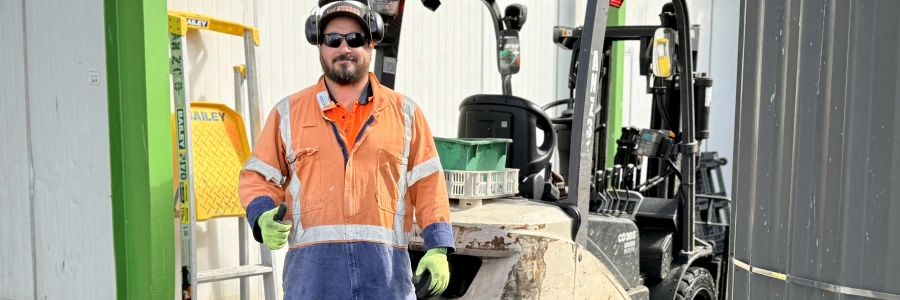
Forklift safety | March and April health and safety focus
Posted on Tuesday, 31 March 2026 under Health & Safety,
Forklifts are used in many industries around the world to help move products and reduce manual handling.
Forklifts also come with some risks that forklift drivers and pedestrians need to keep in mind.
-
Completing daily pre-use checks of each forklift allows us to identify and resolve any issues. Daily checks monitor the key safety points relating to a forklift. If anything is noted as an issue, the forklift should be parked up until it is repaired.
-
Forklift drivers often become accustomed to their work environment; however, because of the nature of our business we often have pedestrians working in the same spaces as forklifts and this adds risk. Concrete/steel posts and barriers around our sites show evidence of damage by forklifts, reinforcing the need for care to be taken when pedestrians are around.
-
Always wear your seatbelt on a forklift.
-
All forklift drivers MUST be trained, licensed and monitored. All forklift drivers must have F endorsements if they’ll be driving on a legal road, as well as holding a valid certificate from a registered training provider. They must also have completed site familiarisation training.
-
Where pedestrians and forklift operations use the same space, both parties must acknowledge each other by maintaining eye contact. Drivers should bring the forks down, put the unit in neutral, and take their hands off the controls.
-
A forklift must be used within its capacity with a secure load – don’t lift items that are too heavy.
-
Forklift drivers must operate at a safe speed – this usually means a maximum of walking pace.
-
Where clear visibility may be impacted, use a spotter when reversing or lifting items.
-
Drivers should not rely solely on mirrors as doing so can increase blind-spots.
-
When driving in reverse a driver must turn around in the seat and look backwards.
-
Do not drive forward with a load that obscures your vision e.g. two pallets or full stillage or frame.
-
At blind corners, doorways or crossing thresholds etc, the driver must always slow down and sound their horn on the approach.
-
The mast and safety canopy create blind-spots – always look for pedestrians who may be in a blind-spot.
-
Forklifts generally steer from the rear. They have multiple blind-spots for the driver and they react differently to a car. Be aware of the turning arc of forklifts – they can turn more sharply than you may expect.
-
Where pedestrians and forklift operations use the same space, pedestrians must make sure they have made eye contact with the forklift operator and have acknowledged their presence using verbal confirmation or hand signals.
-
Pedestrians should keep to one side of any walkway.
-
Anyone near a forklift should be aware of impact areas and the risk of rollover.
-
Keep to the designated walkways.


