
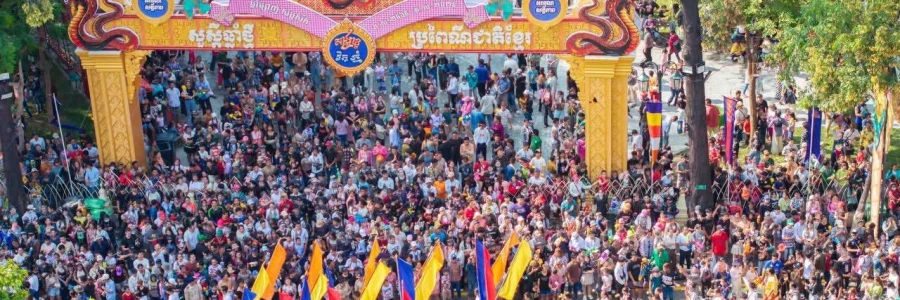
Khmer New Year 2026
Posted on Tuesday, 14 April 2026 under Culture and Belonging,
From Tuesday 14 April to Thursday 16 April, Cambodia is celebrating its new year.
This three-day public holiday, known as Choul Chnam Thmey, signifies the start of the new year.
April is the hottest and driest time of year in Cambodia, making it difficult for farmers to continue working outside, so Khmer New Year traditionally marks the end of the harvest season. It's a good time for farmers to rest after working all year, and before the rainy season arrives in May.
Often people have water fights as a way to wash away the old year. They'll use water guns, buckets, and hoses on people passing by - even if they're in cars or on motorbikes.
There are three distinct days of the new year with different meanings and traditions:
- Maha Songkran (មហាសង្រ្កាន្ត) - the first day of the new year. People dress up and light candles at shrines. For good luck, people wash themselves with holy water in the morning, their chests at noon, and their feet in the evening before they go to bed.
- Virak Vanabat (វិរ:វ័នបត) - the second day, for helping the poor, homeless, and low-income families.
- Vearak Loeng Sak (វារៈឡើងស័ក) - the third day, where Buddhists wash statues and their elders with perfumed water, to wash bad actions away, and to bring longevity, good luck, and prosperity.
The legend of Khmer New Year
Long ago, there was a young, wise scholar named Dhammabal Koma, who could understand the language of birds. His intelligence attracted the attention of Kabil Mohar Prom, the King of the Gods.
Kabil Mohar Prom made a wager with Dhammabal; if he couldn't answer a riddle within seven days he would lose his head, but if he succeeded the god himself would lose his head.
Dhammabal struggled with the riddle for six days, but on the seventh day overheard two eagles discussing the riddle, which helped Dhammabal solve the riddle - so Kabil Mohar Prom honoured the wager and cut off his head.
Because Kabil Mohar Prom's head held immense power, he asked his seven daughters to take turns carrying it each year to make sure the world continues to have health, prosperity, and protection.
The first day of Khmer New Year determines which goddess represents the year - in 2026, it's the goddess Nang Raksasathevi, who's associated with Tuesday and symbolises strength, protection, and determination.
Traditional games
Throughout the new year, you'll often find friends and families out and about, spending time playing traditional games.
- Chol Chhoung is played by two groups of younger people. They throw a rolled up scarf at each other; if a player is hit, they must sing or dance as they return the scarf.
- Chap Kon Kleng is played by adults on the first night of the new year. One person is chosen as the ‘hen’, another is the ‘crow’ and the rest are the chicks. The crow must catch as many chicks as possible, and the hen must protect them.
- Leak Kanseng is played by a group of children sitting in a circle. Someone walks outside the circle while singing a song, and tries to secretly place a rolled up towel behind one of the players. If that player notices, they must grab the towel, chase the standing player, and try hit them with the towel before they sit down in the empty spot. If they don't notice, they become the next person to try drop the towel.


